How to Rank in Google’s Featured Snippets (Position Zero) (2026)
Table Of Contents
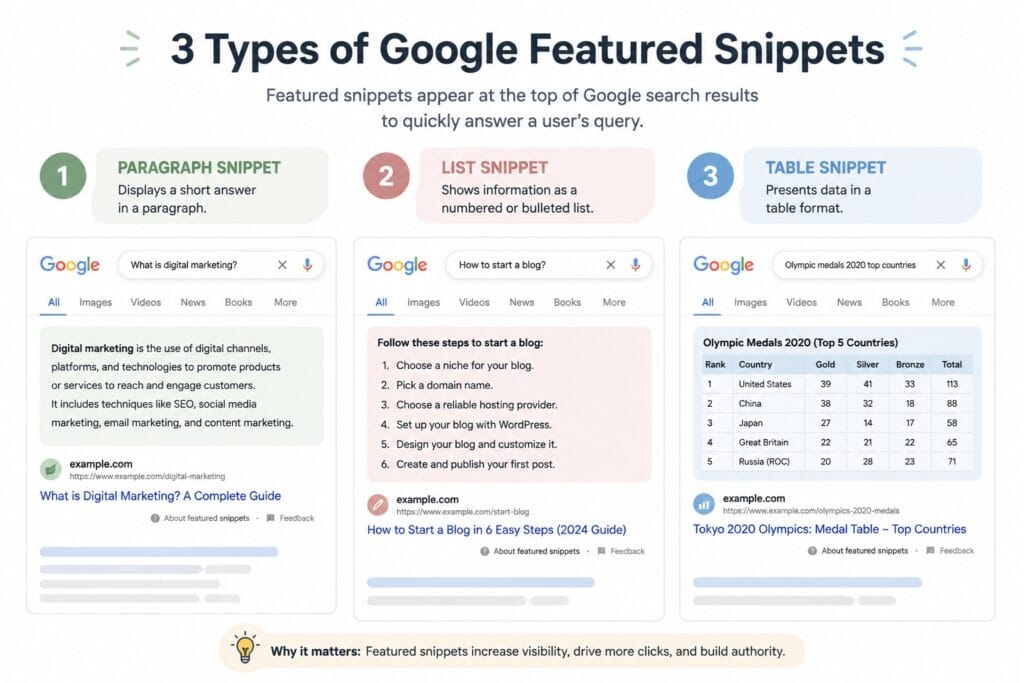
Featured snippets are the boxes that appear at the top of Google search results, above the #1 organic result. They are called position zero because they rank higher than position one. If you can win a featured snippet, you get massive visibility without needing the strongest backlink profile.
What Are Featured Snippets?
Featured snippets are Google’s attempt to answer a user’s question directly on the search results page, without requiring a click. They extract a short answer from a webpage and display it prominently.
There are three main types:
1. Paragraph Snippets (Text Answers)
These are short text blocks, usually 40-60 words, that answer a question directly. They often appear for what is, how to, and why queries.
Example:
Query: What is LED strip light? Answer: LED strip lights are flexible circuit boards populated with surface-mounted light-emitting diodes (SMD LEDs) and other components that typically come with an adhesive backing. They are used for accent lighting, backlighting, and decorative illumination in residential and commercial spaces.
2. List Snippets (Numbered or Bulleted)
These show step-by-step instructions or ranked items. Numbered lists appear for how to and process queries. Bulleted lists appear for feature lists and non-sequential items.
Example:
Query: How to install LED strip lights. Answer: 1. Measure and cut the strip at the marked cut lines. 2. Clean the surface where you will attach the lights. 3. Peel off the adhesive backing and press firmly.
3. Table Snippets (Data Comparisons)
These display data in a table format, often for comparison queries. Google pulls the table directly from a webpage.
Example:
Query: LED strip light types comparison. Answer: Table showing Type, Wattage, Brightness, Best Use Case for 5050, 3528, 2835, and COB strips.
Why Featured Snippets Matter for SEO
Featured snippets offer three major advantages:
Position zero visibility: You appear above the #1 result, often with a larger display.
Higher click-through rates: While some users get their answer from the snippet, many click through for more detail. CTR for snippets can be 2-3x higher than standard results.
Voice search dominance: Voice assistants like Google Home and Siri read featured snippets as answers. As voice search grows, snippets become even more valuable.
How to Optimize for Featured Snippets
Winning a featured snippet requires strategic content formatting. Here is what works:
For Paragraph Snippets
Answer the question in 40-60 words
Place the answer immediately after the question, in a clear paragraph. Do not bury it in a long introduction.
Example structure:
H2: What Is LED Strip Light? [40-60 word direct answer] [Additional detail and context]
Use the question as a heading
Format the question as an H2 or H3 heading. Google uses headings to identify what the section is about.
For List Snippets
Use proper HTML lists
Use ol for numbered lists (steps, rankings) and ul for bulleted lists (features, benefits). Do not use paragraphs with numbers or bullets typed manually.
Start each item with an action verb
Example:
1. Measure the installation area. 2. Cut the strip at marked lines. 3. Clean the mounting surface. 4. Peel adhesive backing. 5. Press firmly for 30 seconds.
Keep list items concise
Each item should be 1-2 lines. Google truncates long list items in snippets.
For Table Snippets
Use HTML tables with clear headers
Use table, thead, th, and td tags. Do not use CSS to simulate tables or images of tables.
Include 3+ rows of data
Google prefers tables with multiple rows. A 2-row table rarely gets featured.
Label columns clearly
Use descriptive header text. LED Type, Wattage, Brightness is better than Type, W, Lumens.
Advanced Snippet Optimization Tactics
Once you have mastered the basics, try these advanced tactics:
1. The Snippet Bait Technique
Create a short, definitive answer early in your content, then expand with detail. The snippet bait is the concise answer. The rest of the content satisfies users who want more.
Example:
[Snippet bait – 45 words answering the question directly] [Detailed explanation with examples, images, and context] [Related questions and answers]
2. FAQ Schema Markup
Add FAQ schema to your page. This helps Google understand that your content contains questions and answers, increasing snippet eligibility.
Basic FAQ schema structure:
FAQPage schema with Question and Answer entities. Include the exact question as the name and a concise answer as the text.
3. Target People Also Ask Questions
The People Also Ask (PAA) boxes often appear alongside featured snippets. Each question in PAA is a potential snippet opportunity.
How to use PAA for snippet optimization:
Search your target keyword
Record all PAA questions
Click each question to expand and see more
Answer each question in your content with a 40-60 word snippet bait
Use the exact question as an H2 or H3
Summary
Featured snippets are the fastest way to get top-of-page visibility without a massive backlink profile. They reward content clarity, not just authority.
To win snippets: answer questions directly in 40-60 words, use proper formatting (lists, tables), place answers near relevant headings, and add schema markup.
Not every query has a featured snippet, and not every snippet is worth targeting. Focus on questions in your niche where you can provide the clearest, most concise answer. Quality beats quantity every time.