What Is SEO? How to Get Free Traffic from Google (2026 Edition)
Table Of Contents
Last updated: July 2026 | 12 min read
Picture this: A procurement manager in Munich types “LED strip light manufacturer USA” into Google. Your website appears first. They click. They browse your products. They send you an inquiry. The total cost to you: zero.
That’s SEO. Not a theory. Not a buzzword. That’s what search engine optimization does for businesses that do it right.
This guide walks you through what SEO actually is—the parts that still matter in 2026, the parts that have changed, and exactly what to do next if you’re starting from zero.
What Is SEO? (Skip the Textbook)
SEO stands for search engine optimization. In practice, it’s the process of making your website more visible when people search for things related to your business—without paying for ads.
Google processes roughly [8.5 billion searches per day as of 2025]. Every one of those searches is someone with a question, a problem, or a credit card. SEO is how your business shows up in the results for the searches that matter to you.
SEO is no longer about earning a position for a specific keyword. It’s about your full search visibility: how often and how prominently you show up across search results that change with every user, every query, and every platform. — adapted from Semrush, What is SEO? (2026)
Why SEO Still Matters in 2026
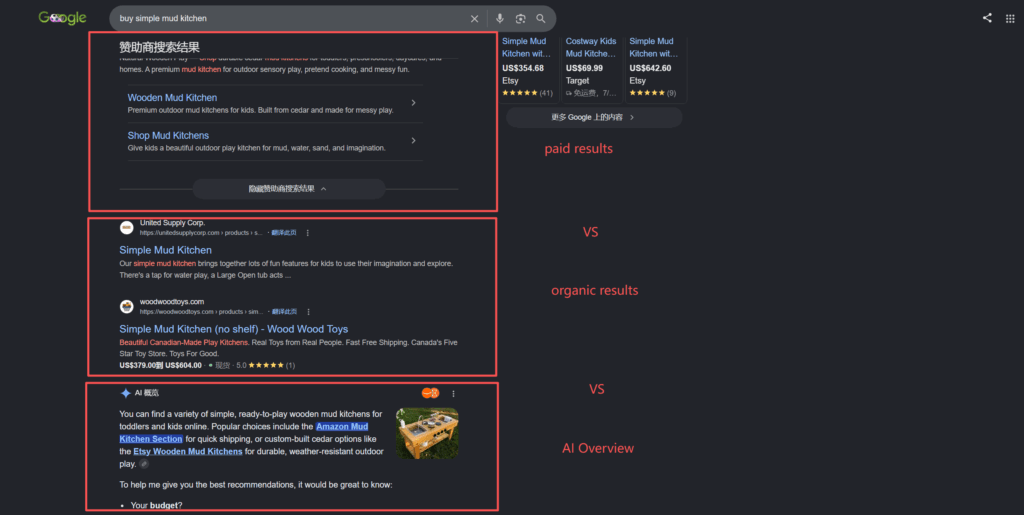
Every year someone says “SEO is dead.” Every year it’s not. Here’s what changed in 2025–2026 and why it matters more, not less:
- AI Overviews are driving more searches, not fewer. Google reported at I/O 2025 that AI Overviews drove over 10% growth in query types where they appear, across major markets like the U.S. and India.Source Google I/O research.
- AI search visitors convert at higher rates. Semrush research found that visitors from AI search sources are worth roughly 4.4x more than organic search visitors, likely because they arrive further along in their decision-making.
- Paid search keeps getting more expensive.
- Average click-through rate: 6.64%.
- Average cost per click: $5.42
- Average conversion rate: 8.18%
- Average cost per lead: $66.69 — Source from Wordstream
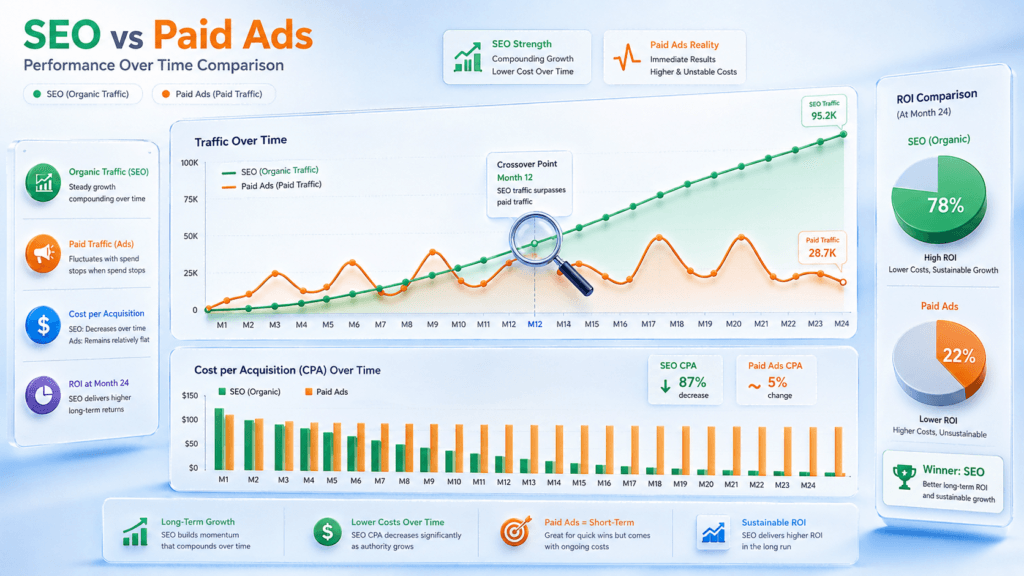
The result: SEO isn’t optional anymore. It’s the single highest-ROI channel for businesses that sell products or services online. Unlike ads, where traffic stops the moment you stop paying, SEO compounds. Every piece of content you create, every link you earn, every page you optimize—they keep working weeks and months later.
How SEO Actually Works (The Minimum You Need to Know)
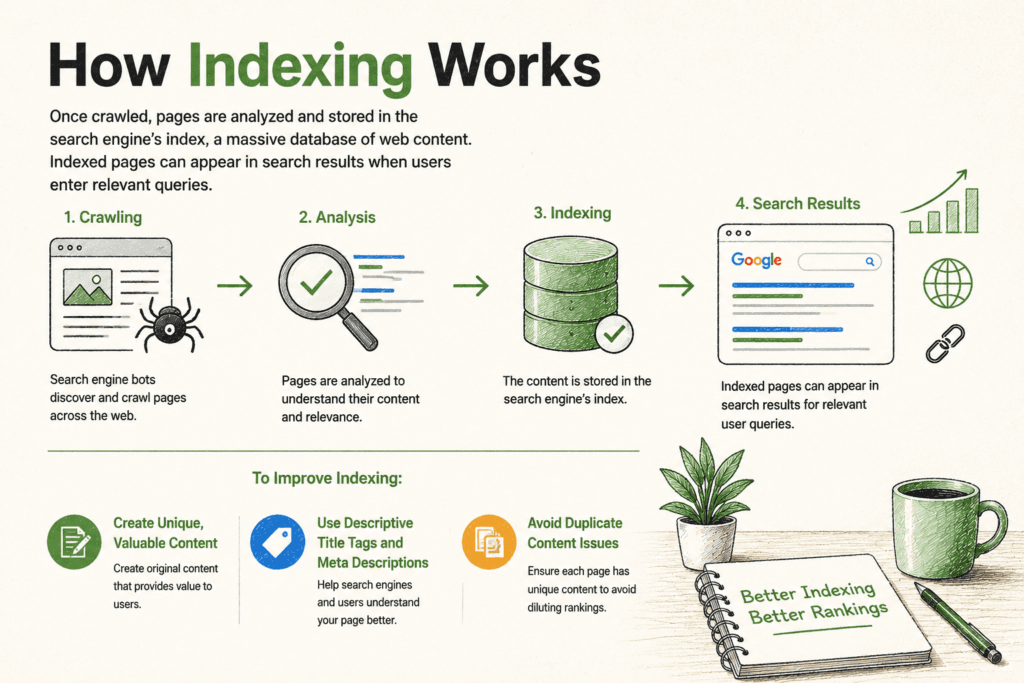
Search engines like Google have three jobs: find content, store it, and decide what to show for each search.
Step 1: Crawling
Google sends automated bots—called crawlers—to discover pages across the web. These bots follow links from one page to another. If your site has broken links, no internal linking structure, or pages that take too long to load, crawlers won’t find everything you want them to.
What this means for you: Submit a sitemap via Google Search Console. Fix broken links. Make sure every important page on your site is linked to from at least one other page.
Step 2: Indexing
Once a page is discovered, Google analyzes it and adds it to its index—a massive database of web content. Pages in the index are eligible to appear in search results. Pages not in the index won’t show up at all.
What this means for you: Avoid duplicate content. Use clear title tags and meta descriptions. Make sure Google can render your pages (JavaScript-heavy sites often fail here). Check your coverage report in Google Search Console.
Step 3: Ranking
When someone searches, Google pulls from its index and ranks results based on hundreds of signals—relevance to the query, quality of content, page speed, backlinks, user experience, and more.
What this means for you: Match your content to what searchers actually want. Build trust through quality backlinks. Make your site fast and mobile-friendly.
SEO vs Paid Ads: The Real Comparison
| SEO | Paid Ads (PPC) | |
|---|---|---|
| Cost per click | $0 | Pay per click (varies by industry, [avg $2-5 for B2B]) |
| Time to results | 3–6 months typically | Immediate |
| Longevity | Compounds over time | Stops when you stop paying |
| Trust perception | Higher (seen as earned) | Lower (seen as paid placement) |
| Best for | Long-term growth, brand building | Product launches, promotions, testing |
I’ve watched businesses spend $30,000–$50,000 a month on Google Ads while ignoring SEO entirely. When the ad budget inevitably got cut, they had nothing. No organic traffic. No leads. No pipeline. SEO is the safety net that keeps delivering after the paid campaign ends.
The Biggest Shift in 2025–2026: SEO in the AI Era
If you’re reading a 2026 guide and it doesn’t mention AI, throw it away. Here’s what’s happening:
- AI Overviews appear at the top of many Google searches, summarizing answers from multiple sources. Your page needs to be cited in these overviews, not just ranked #1 in traditional results.
- ChatGPT and other AI chatbots now cite sources when answering search-related queries. A Semrush study found that domains in Google’s top 10 are far more likely to be cited by AI, but the overlap is only about 35% between AI Mode results and Google’s top 10. -Form Semrush Research
- Search surfaces are multiplying. People search on Google, TikTok, YouTube, ChatGPT, Perplexity, Amazon, and more. SEO now means being visible across all of them, not just one.
The fundamentals—good content, solid technical foundation, authoritative backlinks—haven’t changed. But the surface you’re optimizing for has expanded. If you’re not thinking about how your content gets cited by AI, you’re already behind.
“On-page SEO is fundamental to how AI search tools understand when your content is relevant to a question. Technical SEO makes that content easy to find and use. Off-page SEO shapes what your brand is known for.” — Zach Paruch, AI Visibility & SEO Strategist at Semrush
The Three Pillars of SEO (That Still Apply)
1. On-Page SEO: Content + HTML
This is what most people think of when they hear “SEO.” It includes:
- Title tags and meta descriptions — the headline and summary that appear in search results
- Header structure (H1, H2, H3) — helps both readers and search engines understand your page’s hierarchy
- Content quality — does it actually answer the searcher’s question? This matters more than keyword density
- Internal linking — links between your own pages help Google understand your site structure and distribute authority
- Image alt text — describes images for accessibility and gives Google another signal about your content
2. Off-Page SEO: Links + Authority
Off-page SEO is everything that happens outside your website that affects your rankings. The most important signal: backlinks. When reputable sites link to your content, Google interprets that as a vote of confidence.
Ways to earn links:
- Create original research or data that others want to cite
- Publish guest posts on relevant industry blogs
- Build genuine relationships with journalists and bloggers in your space
- Get listed in relevant directories and resource pages
Note: Not all backlinks are equal. One link from a high-authority site like Forbes or a respected industry publication is worth more than 50 links from random blog directories.
3. Technical SEO: Site Health
Technical SEO is the infrastructure layer. If search engines can’t crawl, load, or understand your site, nothing else matters.
- Page speed — Google explicitly uses this as a ranking factor. You can measure your website’s speed using Google’s official speed test page.Websites scoring above 85 points are considered to have passed the speed test.
- Mobile-friendliness — Google uses mobile-first indexing. If your site isn’t usable on a phone, you’re losing rankings.
- XML sitemap + robots.txt — tell Google which pages to crawl and which to skip
- Structured data (Schema markup) — helps Google understand your content type (product, article, FAQ, etc.) and can earn you rich results like star ratings or FAQ snippets
Your 4-Step Action Plan for SEO (Starting Today)
Step 1: Find Out What Your Customers Are Already Searching
Don’t guess. Use data:
- Google Search Console — shows you what queries are already bringing people to your site. Free, first stop.
- Competitor analysis — plug your competitors’ URLs into Ahrefs or Semrush and see what keywords they rank for
- Long-tail keywords — focus on specific, intent-rich phrases
Step 2: Create Content That Answers Their Questions
This is where most people go wrong. They write about what they want to say, not what their customers are searching for.
- Write for humans first, search engines second
- Go deep — 1,500+ words for informational guides, 500–800 words for product pages
- Use headers, bullet points, and images to break up text
- Include internal links to related content on your site
Step 3: Optimize Your Pages for Both Google and AI
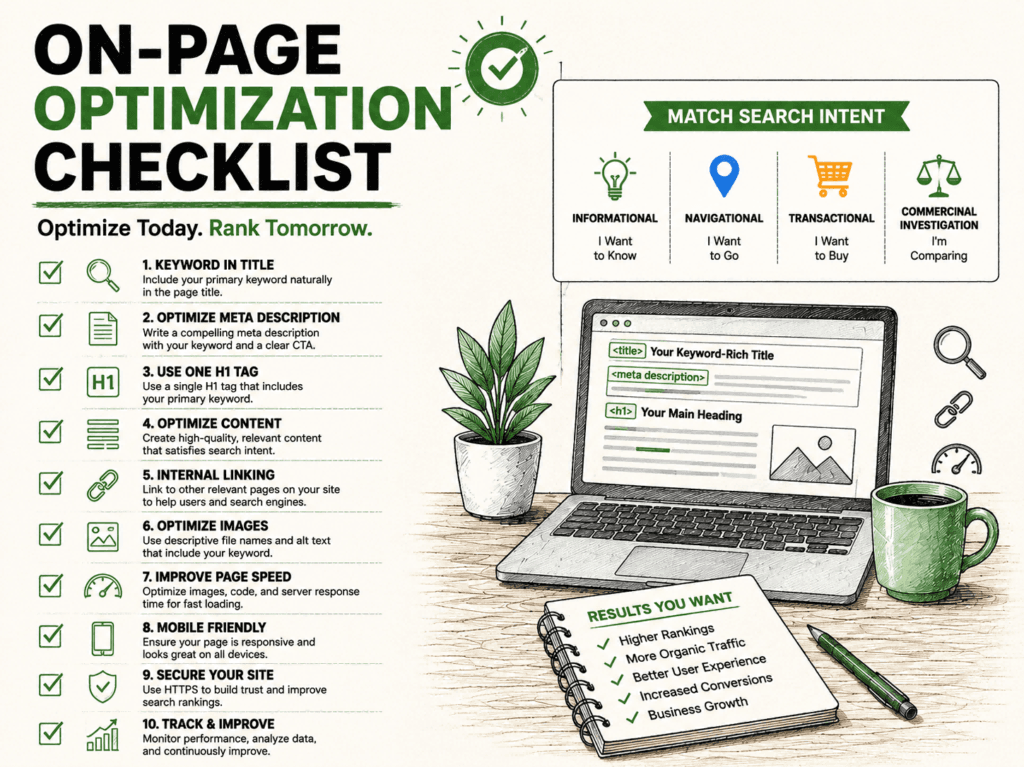
- Include your target keyword in the title tag, H1, and naturally throughout the body
- Write meta descriptions that encourage clicks (under 160 characters)
- Add alt text to every image
- Structure content so both search engines and AI can parse it clearly
Step 4: Build Authority
Rankings don’t happen in a vacuum. Trust comes from:
- Backlinks from reputable sites — still the strongest ranking signal
- Brand mentions — even unlinked mentions help
- Social proof — reviews, case studies
Common Beginner Mistakes (I’ve Made Every One)
- Ignoring search intent. You wrote a product page for a question someone is asking.
- Keyword stuffing. “Our led strip lights are the best led strip lights for led strip light buyers.” Real. I’ve seen this. It doesn’t work.
- Skipping technical basics. A slow site, broken links, or a missing sitemap can undo all your content work.
- Giving up after 8 weeks. SEO is a marathon.
- Copying competitors. Find your angle.
FAQs
Can I do SEO myself? Yes. Start with free tools—Google Search Console, Google Analytics, and a keyword research tool. Learn as you go.
How long does SEO take? 3–6 months to see meaningful results. Technical fixes can show impact in weeks. Content and link building take longer.
Is SEO really free? The traffic itself is free. But SEO costs time and often requires investment in tools or professional help.
What’s the difference between SEO and GEO? GEO (Generative Engine Optimization) focuses on AI tool citations. Most experts agree SEO already covers this. source
SEO Tools I Actually Use
Free:
- Google Search Console
- Google Analytics
- Screaming Frog (free up to 500 URLs)
- PageSpeed Insights
Paid (worth it):
- Ahrefs — best for competitor research and backlinks
- Semrush — all-in-one platform
- Moz Pro — rank tracking and site audits
Start Today (Not Next Month)
Here’s the thing about SEO: the best time to start was six months ago. The second best time is today.
You don’t need to understand every algorithm update. You need to:
- Set up Google Search Console
- Find three topics your customers search for
- Write one page that answers each better than anything else online
- Make sure Google can find those pages
That’s the starting line. Everything else—link building, schema markup, AI optimization—comes after you have content worth ranking.
The companies that win with SEO aren’t the ones with the biggest budgets. They’re the ones that start and don’t stop.
🔗 推荐插入的内链锚文本
- “search intent” → 链到 brandwisp.com 上的 Search Intent 文章 (ID:376)
- “Google Search Console” → 链到站内 GSC 教程页(如有)
- “keyword research” → 链到 How to Find Your Real SEO Competitors (ID:176)
- “content marketing” → 链到 Content Marketing for SEO (ID:186)
- “backlinks” → 链到 Link Building 文章 (ID:189)
- “technical SEO” → 链到站内 Technical SEO 相关文章