Search Intent Types Explained: How to Match What People Actually Want (2026)
Table Of Contents
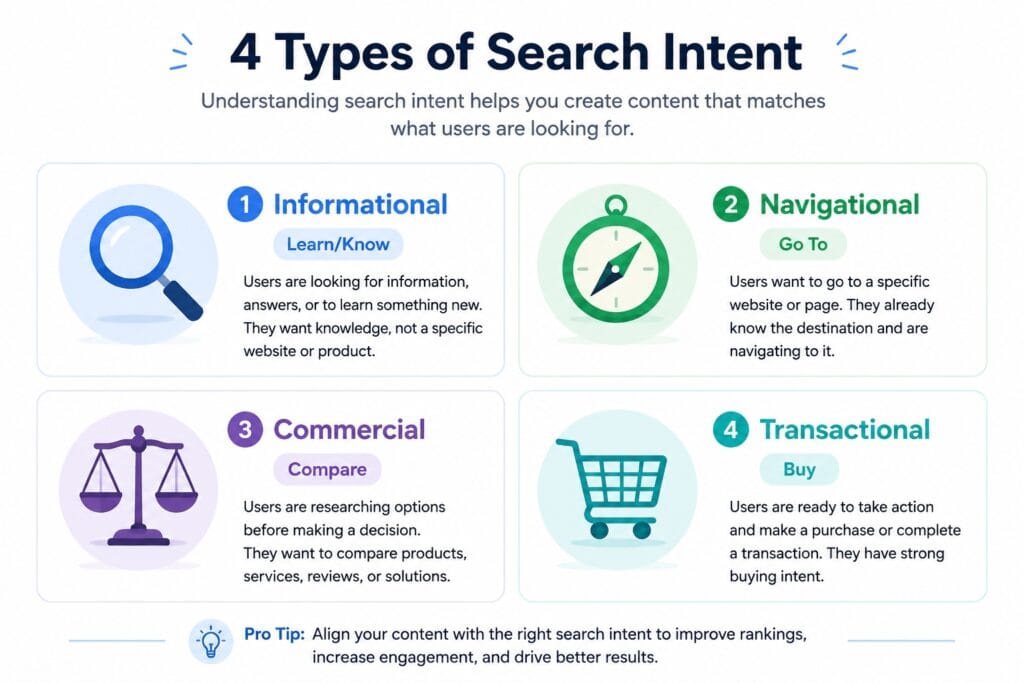
Most SEO beginners focus on keywords. They find a word with high search volume and try to rank for it. That’s the wrong approach.
The right approach? Focus on search intent. What does the person typing that query actually want? If you don’t match their intent, you won’t rank — and even if you do, they won’t convert.
1.Why Search Intent Matters More Than Keywords
Google’s goal is to give users exactly what they’re looking for. If someone searches ‘buy LED strip lights’ and your page is a 3,000-word guide about LED technology, Google won’t rank you. The user wants to buy, not learn.
I’ve seen businesses target high-volume keywords and get traffic that never converts. They ranked for ‘LED lights,’ but the visitors wanted information, not products. The bounce rate was 90%. Time on site was 15 seconds.
2.The 4 Types of Search Intent
1. Informational Intent: ‘I Want to Know’
The user wants to learn something. They’re in research mode, not buying mode.
Examples:
- ‘what is LED strip light’
- ‘how to install LED strip lights’
- ‘difference between 5050 and 3528 LED’
- ‘why do LED lights flicker’
Content that matches:
- Blog posts and guides
- How-to tutorials
- Explainers and definitions
- FAQs
Informational content rarely converts directly, but it builds authority and captures people early in their research. Someone reading ‘what is LED strip light’ today might buy from you in 3 months.
2. Navigational Intent: ‘I Want to Go to a Specific Site’
The user knows exactly where they want to go. They’re typing a brand name or specific URL.
Examples:
- ‘Amazon LED strip lights’
- ‘Philips Hue official website’
- ‘YouTube LED installation tutorial’
You can’t really compete for navigational intent unless it’s your own brand. The user already knows what they want. Focus on building brand awareness so people search for you directly.
3. Transactional Intent: ‘I Want to Buy Now’
The user is ready to purchase. They’re looking for a product, price, or place to buy.
Examples:
- ‘buy LED strip lights wholesale’
- ‘LED strip light manufacturer China’
- ‘best price RGB LED strip 5 meter’
- ‘order custom LED strip lights bulk’
Content that matches:
- Product pages
- Category pages
- Pricing and quote pages
- Checkout and cart pages
This is where the money is. Transactional keywords have lower search volume but much higher conversion rates. Someone searching ‘buy LED strip lights wholesale’ is a qualified lead.
4. Commercial Investigation: ‘I’m Comparing Before Buying’
The user is researching before making a purchase decision. They’re comparing options, reading reviews, and looking for the best choice.
Examples:
- ‘best LED strip light manufacturer 2026’
- ‘LED strip light vs rope light outdoor’
- ‘top 10 LED strip light brands China’
- ‘Govee vs Philips Hue LED strip review’
Content that matches:
- Comparison articles
- Best-of lists and roundups
- Review posts
- Case studies
Commercial investigation content converts better than informational but not as well as transactional. The reader is warm but not hot. Your job is to convince them you’re the best choice.
3.How to Determine Search Intent for Any Keyword
Before writing content for any keyword, analyze what Google already shows. Google is telling you exactly what intent it thinks the query has.
My 3-step process:
- Search the keyword in Google and look at the top 10 results
- Analyze the content type: Are they blog posts? Product pages? Comparison tables?
- Match your content: Create the same type of content, but better
If the top results are all product pages, don’t write a blog post. If they’re all listicles, don’t write a single product page. Google has already determined what users want for that query.
4.Search Intent and Content Strategy
Your content strategy should cover all four intent types, guiding users from awareness to purchase.
The funnel approach:
- Top of funnel (Informational): ‘What is LED strip light’ → educational blog post
- Middle of funnel (Commercial): ‘Best LED strip light manufacturer’ → comparison article
- Bottom of funnel (Transactional): ‘Buy LED strip lights wholesale’ → product page
- Retention (Navigational): ‘YourBrand LED strips’ → brand search, loyalty
Each piece of content should link to the next stage. Your informational post should link to your comparison article. Your comparison article should link to your product page.
5.Common Mistakes in Matching Intent
I’ve audited hundreds of sites. Here are the most common intent mismatches I see:
- Blog post targeting transactional keywords: Writing ‘How to Choose LED Strip Lights’ when users want ‘Buy LED Strip Lights’.
- Product page targeting informational keywords: A product page ranking for ‘what is LED’ will fail.
- Ignoring commercial investigation: Not creating comparison content means losing warm leads.
- One-size-fits-all content: Trying to rank one page for multiple intents.
Summary
Search intent is the foundation of modern SEO. Keywords tell you what people type. Intent tells you why they type it.
Before creating any content, ask: What does the person searching this actually want? Then give them exactly that.
Match intent, and Google will reward you. Mismatch intent, and even perfect SEO won’t save you.