How to Find Your Real SEO Competitors (The Right Way) (2026)
Table Of Contents
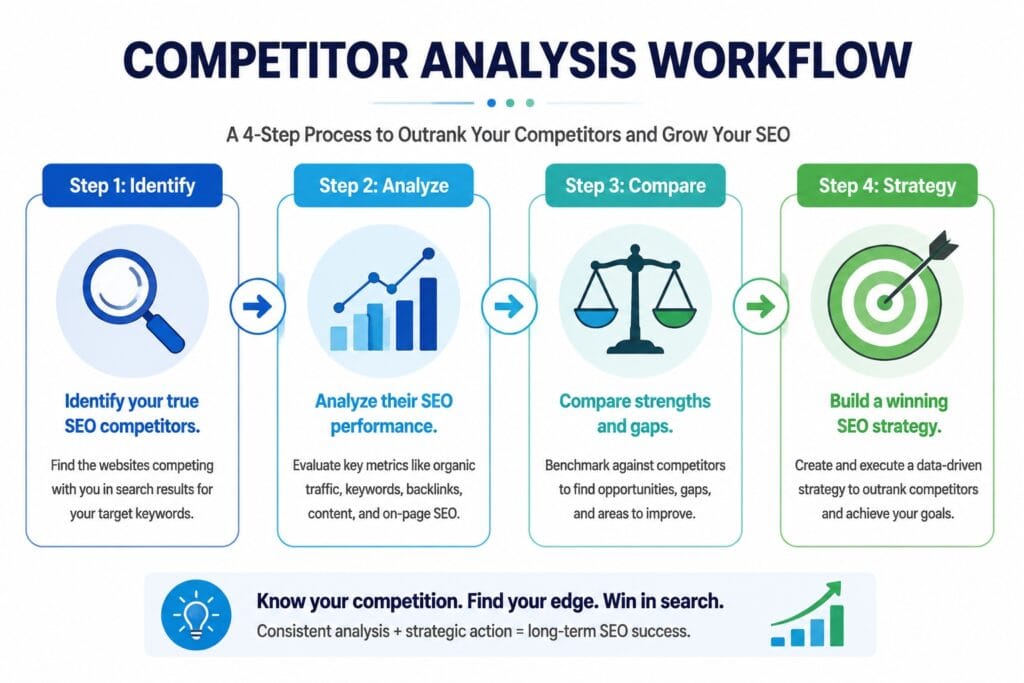
Most businesses think they know their competitors. They list the companies they compete with for customers. But SEO competitors are different. They’re the sites ranking for your target keywords — and they might not be who you expect.
1.Why Traditional Competitor Analysis Fails
Your business competitors sell similar products. Your SEO competitors rank for the same keywords. These are often different companies.
Example:
You sell LED strip lights. Your business competitors are other LED manufacturers. But when you search ‘how to install LED strip lights,’ the top results are DIY blogs, YouTube videos, and home improvement sites — not manufacturers.
If you only analyze other manufacturers, you miss the real competition. You need to find who’s actually ranking for the keywords you want to target.
2.The Right Way to Find SEO Competitors
Step 1: Start with Your Target Keywords
Don’t start with companies. Start with keywords. List 10-20 keywords you want to rank for. Include:
Informational keywords (what your customers search when learning)
Commercial keywords (what they search when comparing)
Transactional keywords (what they search when ready to buy)
Long-tail variations (3-5 word phrases with specific intent)
Example keyword list for LED strip lights:
‘what is LED strip light’ (informational)
‘best LED strip light manufacturer 2026’ (commercial)
‘buy LED strip lights wholesale China’ (transactional)
‘5050 vs 3528 LED chip difference’ (long-tail informational)
‘RGB LED strip light waterproof outdoor 5m’ (long-tail transactional)
Step 2: Search Each Keyword and Record Top 10
For each keyword, search Google and record the top 10 results. Use a spreadsheet with columns for:
Keyword
Position (1-10)
Domain
Page title
Content type (blog post, product page, category page, etc.)
Notes (what makes this page rank?)
Do this for all 20 keywords. You’ll start seeing patterns. Some domains appear again and again. These are your real SEO competitors.
Step 3: Identify Patterns and Group Competitors
After analyzing 20 keywords, you’ll see three types of competitors:
Direct competitors: Other businesses selling similar products. They compete for transactional keywords.
Content competitors: Blogs, media sites, and informational platforms. They compete for informational keywords.
Aggregator competitors: Amazon, Alibaba, directories. They compete for broad commercial keywords.
Each type requires a different strategy. You can’t beat Amazon for ‘LED strip lights’ with a product page. You need content or a unique angle.
3.Tools to Speed Up Competitor Analysis
Manual analysis works but takes time. These tools speed up the process:
Ahrefs Site Explorer: Enter your domain and see ‘Competing domains’ — sites ranking for the same keywords.
Semrush Organic Research: Shows organic competitors and keyword overlap.
Moz Link Explorer: Compare link profiles with competitors.
Google Search Console: See which queries you rank for, then search those queries to find competitors.
I use a combination. Tools find candidates. Manual analysis confirms whether they’re real competitors or just ranking for unrelated terms.
4.What to Analyze Once You Find Competitors
Finding competitors is just the start. You need to understand why they rank. Here’s my analysis framework:
1. Content Analysis
Word count: How long is their content?
Structure: How do they use headers, lists, images?
Depth: Do they cover the topic completely or superficially?
Freshness: When was it last updated?
2. Backlink Analysis
Total backlinks: How many links point to the page?
Link quality: Are the links from reputable sites?
Anchor text: What words do they use to link?
Link velocity: Are they gaining links quickly?
3. Technical Analysis
Page speed: How fast does their page load?
Mobile optimization: Is their site mobile-friendly?
Schema markup: Do they use structured data?
Internal linking: How do they link within their site?
5.Turning Analysis into Action
Competitor analysis is useless if you don’t act on it. Here’s how to turn insights into strategy:
Content gaps: Find topics they rank for that you don’t. Create better content.
Weaknesses: Find where their content is thin or outdated. Outdo them.
Strengths: Learn what they do well. Don’t copy — adapt to your brand.
Differentiation: Find angles they haven’t covered. Unique content wins.
6.Summary
Finding your real SEO competitors isn’t about listing similar businesses. It’s about finding who’s actually ranking for your target keywords.
Start with keywords. Search them. Record who ranks. Analyze why. Then create content that beats them at their own game.
Your competitors are your best teachers. They’ve already done the hard work of figuring out what Google wants. Learn from them, then do it better.