Why Keyword Tools Lie (And What to Use Instead) (2026)
Table Of Contents
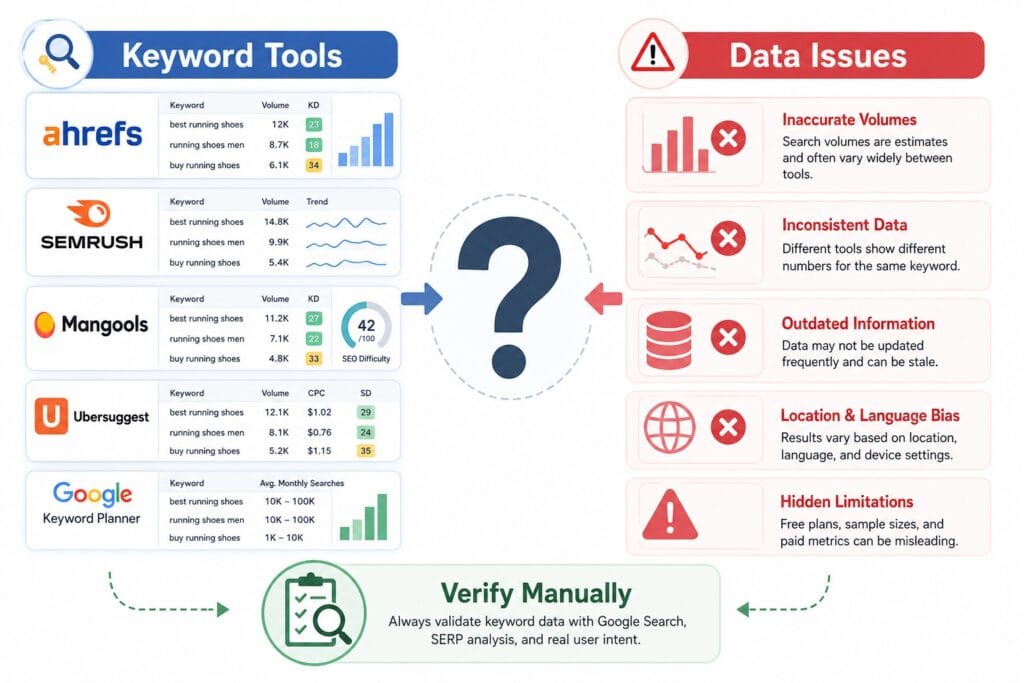
I used to love keyword research tools. Ahrefs, Semrush, Moz — I spent hours analyzing search volumes, keyword difficulty scores, and competition metrics. Then I realized something: the data was often wrong, and following it led me to create content that never ranked.
The Problem with Keyword Tool Data
Keyword tools estimate search volume based on samples, models, and third-party data. They’re not using Google’s actual data. This leads to three major problems:
1. Search Volume Is Often Inaccurate
I once targeted a keyword that Ahrefs showed as 5,000 monthly searches. After ranking #1, Google Search Console revealed the actual traffic was 800 visits per month. The tool overestimated by 6x.
This happens because:
Tools use clickstream data from browser extensions and ISPs (small samples)
They extrapolate from limited data to estimate total volume
Seasonal trends and regional variations are often smoothed out
New or rapidly changing keywords have no historical data to model
2. Keyword Difficulty Scores Mislead
A keyword with ‘low difficulty’ might seem like easy pickings. But the score is based on the backlink profiles of current ranking pages — not on content quality, user intent, or your ability to create something better.
I’ve seen ‘low difficulty’ keywords dominated by major brands with weak content. The tool says it’s easy because the pages have few backlinks. But Google ranks them due to brand authority, which the tool can’t measure.
3. They Ignore Search Intent
Tools show keywords as isolated terms. They don’t tell you what the person searching actually wants. A keyword like ‘LED strip lights’ could mean:
Informational: ‘What are LED strip lights?’ (blog post)
Commercial: ‘Best LED strip lights 2026’ (comparison article)
Transactional: ‘Buy LED strip lights’ (product page)
Navigational: ‘Philips Hue LED strip lights’ (brand page)
If you create the wrong content type for the intent, you won’t rank — regardless of what the keyword difficulty score says.
What to Use Instead of (Or Alongside) Keyword Tools
I still use keyword tools, but I don’t rely on them blindly. Here’s my current research process:
1. Google Search Console (Free, Real Data)
This is your goldmine. It shows the actual queries people use to find your site, your average position, and click-through rates.
What to look for:
Queries where you rank #5-15 (easy wins with optimization)
High-impression, low-CTR queries (your title/description needs work)
Queries you rank for but don’t have dedicated content (create new pages)
Long-tail variations of your target keywords (content ideas)
2. Google’s ‘People Also Ask’ and Related Searches
These are Google’s own suggestions for what people search next. They’re based on actual user behavior, not estimates.
How to use them:
Search your target keyword
Record all ‘People Also Ask’ questions
Scroll to bottom and record ‘Related searches’
Click each PAA question to expand and see more questions
Use these as subheadings and content sections in your article
3. Reddit, Quora, and Industry Forums
People ask questions in forums that they don’t ask in Google. These reveal real pain points, language, and concerns.
How to use them:
Search [your topic] + ‘reddit’ or ‘quora’ in Google
Read threads with 50+ comments
Note exact phrases people use (these are your keywords)
Identify unanswered questions (content opportunities)
Look for common complaints about competitors (your differentiators)
4. Competitor Content Analysis (Manual)
Instead of trusting a tool’s competition score, look at who’s actually ranking and analyze their content manually.
My manual analysis checklist:
Word count: How thorough is their content?
Depth: Do they answer follow-up questions?
Media: Do they use images, videos, infographics?
Freshness: When was it last updated?
Gaps: What are they missing that you can cover better?
A Better Keyword Research Process
Here’s the process I use now, combining tools with real data:
Step 1: Start with Google Search Console
Find queries you’re already ranking for (#5-20). These are proven opportunities — Google already thinks you’re relevant.
Step 2: Expand with PAA and Related Searches
For each query, search Google and collect all PAA questions and related searches. These reveal the full topic cluster.
Step 3: Check Forums for Language and Pain Points
Search Reddit/Quora for your topic. Note the exact phrases people use. These often become your best long-tail keywords.
Step 4: Use Tools for Validation (Not Discovery)
Use Ahrefs/Semrush to check if a keyword has some search volume (even if inaccurate) and to see who ranks. But don’t let the tool decide your content strategy.
Step 5: Create Content Based on Intent, Not Volume
Choose topics based on search intent and your ability to create the best answer. A 200-search keyword with high intent beats a 10,000-search keyword with low intent.
Summary
Keyword tools are useful, but they’re not gospel. Their data is estimated, their difficulty scores are simplistic, and they ignore the most important factor: search intent.
Use Google Search Console for real data. Use PAA and related searches for topic ideas. Use forums for language and pain points. Use tools for validation, not strategy.
The best keyword research happens when you understand your audience, not when you trust a tool’s score.