Content Calendar for SEO: Planning 6 Months Ahead (2026)
Table Of Contents
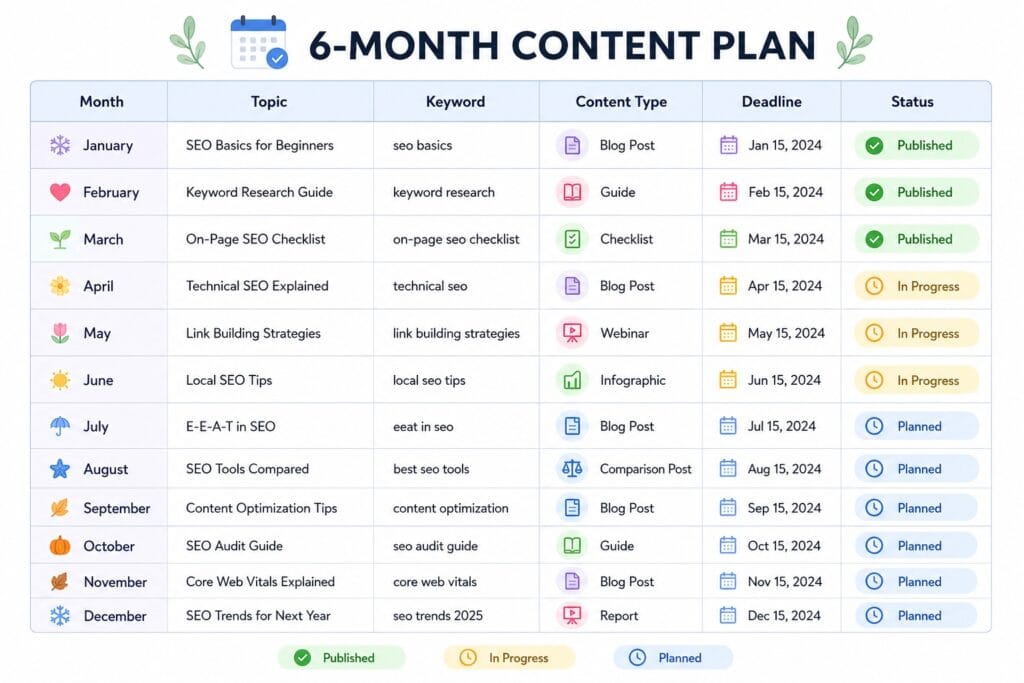
Most businesses publish content randomly. They write when they have time, about whatever seems interesting. This is a recipe for inconsistent traffic and missed opportunities. A content calendar transforms random publishing into strategic growth.
Why You Need a Content Calendar
A content calendar is not just a schedule. It is a strategic tool that aligns your content production with business goals, seasonal trends, and SEO opportunities.
Benefits of planning 6 months ahead:
Seasonal alignment: Publish content before peak search seasons. Holiday guides should go live in October, not December.
Resource planning: Know when you need writers, designers, and developers. No more last-minute scrambles.
Consistent publishing: Search engines and audiences reward consistency. A calendar ensures you publish regularly.
Strategic topic coverage: Ensure you cover all stages of the buyer’s journey, not just top-of-funnel content.
Team accountability: Everyone knows their deadlines. No more ‘I thought you were writing that.’
Performance tracking: Plan time to review and update old content, not just create new content.
How to Build a 6-Month Content Calendar
Step 1: Define Your Goals and KPIs
Before planning topics, know what you are trying to achieve. Different goals require different content strategies.
Common SEO content goals:
Increase organic traffic: Focus on high-volume informational keywords
Generate leads: Create gated content and comparison guides
Build brand authority: Publish original research and expert guides
Support product launches: Create pre-launch content and tutorials
Improve conversions: Focus on bottom-of-funnel content and case studies
I recommend picking 2-3 primary goals. Everything in your calendar should serve at least one of them.
Step 2: Audit Your Existing Content
Before creating new content, know what you already have. A content audit reveals gaps and opportunities.
My audit process:
List all existing content (URL, title, publish date, word count, traffic, rankings)
Identify top performers (high traffic, good rankings) — plan to update and expand these
Identify underperformers (low traffic, poor rankings) — decide to improve, consolidate, or remove
Find content gaps (topics your competitors cover that you do not)
Map content to buyer journey stages — are you missing middle or bottom-of-funnel content?
Step 3: Identify Seasonal and Trending Topics
Some content has predictable seasonal demand. Plan these months in advance.
Seasonal content examples for LED lighting:
January: ‘LED Lighting Trends for [Year]’ — publish in late December
March: ‘Outdoor LED Lighting for Spring’ — publish in February
June: ‘LED Pool Lighting Ideas’ — publish in May
September: ‘Holiday LED Decoration Guide’ — publish in August
October: ‘Halloween LED Lighting Effects’ — publish in September
November: ‘Black Friday LED Deals’ — publish in late October
Use Google Trends to verify seasonal patterns. Search your keywords and set the timeframe to ‘Past 5 years’ to see predictable spikes.
Step 4: Plan Your Pillar and Cluster Content
Remember the silo method from the internal linking guide? Your calendar should build out complete silos, not random one-off posts.
Example 3-month silo plan:
Month 1: Publish pillar page ‘Complete Guide to LED Strip Lights’ (3,000 words)
Month 2: Publish 3 sub-pages: ‘How to Install LED Strip Lights’, ‘5050 vs 3528 LED Chips’, ‘Best LED Strip Light Controllers’ (1,500 words each)
Month 3: Publish 2 more sub-pages: ‘LED Strip Light Troubleshooting’, ‘How to Cut and Reconnect LED Strips’ + update pillar with internal links to new content
This builds topical authority systematically. One pillar per quarter is a sustainable pace for most teams.
Step 5: Assign Topics to the Calendar
Now fill in the calendar. I use a spreadsheet with these columns:
Publish Date: Target publication date
Topic/Title: Working title
Content Type: Pillar, sub-page, listicle, guide, comparison, etc.
Target Keyword: Primary keyword
Search Intent: Informational, commercial, transactional
Funnel Stage: Top, middle, bottom
Word Count: Target length
Writer: Assigned writer
Status: Planned, brief ready, writing, editing, published
Silo/Cluster: Which pillar this belongs to
Notes: Seasonal relevance, product launch tie-in, etc.
Content Calendar Templates and Tools
You do not need expensive software. Here are the tools I use:
Google Sheets: Free, collaborative, flexible. My default for small to medium teams.
Trello: Visual Kanban boards. Good for tracking content through stages.
Asana: More robust project management. Good for larger teams with complex workflows.
CoSchedule: Built for content marketing. Includes social scheduling and headline analyzer.
Notion: All-in-one workspace. Great for combining calendar, briefs, and documentation.
Balancing New Content and Content Updates
A common mistake is focusing only on new content. Updating old content often delivers faster ROI.
My 70/30 rule:
70% new content: Building new pillars and clusters
30% content updates: Refreshing old posts, adding new sections, updating stats and examples
Content to prioritize for updates:
Posts ranking #5-15 (small improvements can push them to page one)
Posts with declining traffic (Google sees them as stale)
Posts with outdated information (old stats, discontinued products, expired links)
Posts that competitors have outranked (analyze what they added that you lack)
Summary
A content calendar transforms random publishing into strategic SEO growth. Plan 6 months ahead. Align with seasonal trends. Build complete silos. Balance new content with updates. Track performance and adjust.
The best content strategy is not the one with the most posts. It is the one with the most intentional posts. Every piece of content should serve a goal, target a keyword, and fit a silo.
Start planning. Your future traffic depends on the decisions you make today.